Showing posts with label Cold processed soap. Show all posts

Wednesday, 17 August 2016

Funnel Pour Design - 2nd Attempt

Slab cut into logs

Following on from my natural colourants experiment, I poured the remaining batter into a slab mould using the funnel pour technique.

To do this technique, you need to slowly pour one colour into the mould from one spot.  Repeat this with another colour and pour directly in centre of the first colour.  Keep repeating this with the other colours.  To add variation to your design, pour different amounts of batter for each layer.

Below are some pictures of the cut slab.  Colourants used are: Cocoa Powder, Powdered Strawberry, Alkanet / Brazilian Purple Clay, Alkanet and Indigo (Last two failed to produce colour and thus appear as pale cream)


The Purple Brazilian Clay has turned out as a
 soft lavender colour

Tuesday, 16 August 2016

Experimenting With Colour

Left to Right:  Powdered Strawberry, Indigo, Alkanet and Brazilian Purple Clay,
Alkanet, Cocoa Powder

These are the results of my experiment on the weekend using natural ingredients to colour my cold processed soap.

My soap batter was made up of the following base oils.  Olive Oil, Coconut Oil, Rice Bran Oil & Cocoa Butter.

Into 500 ml of batter I added:

1. 2 tsp of Strawberry Powder - Initially there was a faint smell of strawberry. Four days later, there is no indication of the smell of strawberries, and the soap has turned a light tan colour.

2. 4 tsp of infused Indigo - Initially, there was a pale blue tint to the soap.  However, after four days, the soap appears white.  I don't think this will deepen in colour but will check back in a week.  Most likely, I will need to increase the quantity of infused oil.

3. 1 tsp Brazilian Purple Clay mixed with 2 tsp Infused Alkanet - I'm really loving this colour and I'm hoping this won't deepen too much.

4. 2 tsp Alkanet - Initially there was a very pale pink tinge to the soap but it seems I have completely missed the mark and used too little Alkanet infusion.  At the moment, I can't see any colour tint to this soap.  Back to the drawing boards for this one :-(

5.  2 tsp Cocoa Powder - This is a nice brown colour to the soap.  This one I think will darken over the next few days as it is exposed to the air.

Even though some of the colours haven't turned out how I thought they would, I am really happy with the colours produced and how creamy and complimentary they look all lined up together.

Heavenly Scent

I'm so in love with this essential oil blend of Ylang Ylang, Rose Geranium and Vanilla; I first made this just over 2 years ago.  The sultry, seductive blend compliments the natural colourants of cocoa powder and Australian Pink Clay.

For this batch, I used 2tsp of both cocoa powder and pink clay per 500g of soap batter. I wonder what the colour will be like after it has finished curing?  Originally I had planned to make even lines between the colours (sort of like neopolitan icecream) alas, for some reason, the uncoloured batter thickened up quicker than the other two and it resulted in more ploops instead of nice straight lines.  Next time I'll have a serious chat with the soap pixies and tell them to behave themselves :-)  Initially, it sort of plopped itself over the place and during the initial saponification process, it looked like a very sunburnt ......... well I'm not really sure what it looked like :-)

Not looking too pretty at this stage

Glycerin Rivers

Glycerin Rivers Coursing Through the Soap
I didn't mean to get a 'tiger' pattern in this soap, but I really like it.  You see, this pattern was created by rivers of glycerin forming in my soap during the saponification process.  Glycerin occurs naturally in cold processed soap and is part of the reason that soaps made in this manner tend to be very moisturising and nourishing for your body. So why did this occur?  During the saponification and curing process, my soap got very hot and basically, little rivers of glycerin formed in between other oils which had started to solidify.  It is still fine to use; the translucent parts just happen to be a little bit softer.

In fact, often when people comment that soap is very drying to the skin and that their skin is left feeling tight, what they are referring to is commercially produced soap. Large-scale commercial production of soap often deliberately remove the glycerin and add it to moisturising products such as lotions marketing the lotion or cream as a moisturiser to combat the 'dried leather' feel associated with soap.

Poor soap, it gets such a bad wrap at times all because people are led to believe soap has to be drying.

If you regularly use cold processed soap full of moisturising oils, you will find over time the need to use moisturisers diminishes.

You can see in this photo how the parts of soap with
Glycerin Rivers are more translucent

Sunday, 31 July 2016

Infusing Natural Colourants

I love using natural colourants in my soap making, not only can you get a gorgeous Symphony of colour variations, you also have the added bonus of knowing that they have been derived from nature.

So what's on the soapmaking menu today?

Clockwise from the top.
Spirulina, Paprika, Alkanet, Madder Root
Indigo, Turmeric, Australian Bush Tomato
Centre: Chlorophyll

I am infusing these colourants in light olive oil. As it is winter and I don't have alot of shelving space alongside windows, I'm opting for the warm infusing method.  This involves gently warming the oils slowly over 3-4 hours in simmering water using a double boiler.  It is important when using this method to not "cook" the oil.

What colours might I expect the infused oils to produce?

Spirulina - blue-green colour

Paprika - Salmon to orange colour

Alkanet - Pinkish red through to purplish blue

Madder Root - Light pink to earthy red

Indigo - Blue

Turmeric  - Lemony yellow to earthy gold.

Australian Bush Tomato - I'm not sure what to expect.  Perhaps an orange to red colour.

Chlorophyll - Pale green

Colourants waiting to be infused. Left to Right:
Spirulina, Australian Bush Tomato, Alkanet,
Madder Root, Indigo & Turmeric

You can see in this image that some of the colourants started to infuse themselves without the need of the water bath.

Thursday, 28 July 2016

Funnel Pour Design


With the left over batter from my 2nd attempt at creating a drop swirl design, I made a small batch of soap using the funnel pour technique.

Wowser!! I really love the end result. Cut into small cubes I think they look stunning.  It is amazing the results you can achieve using natural colourants and botanicals.

Tuesday, 26 July 2016

Drop Swirl Design - 2nd Attempt

Drop Swirl Design - Thin Trace

Here are the results of my second attempt at creating a drop swirl design.  This time I poured my batter at a thinner trace.

Colourants: Activated charcoal & paprika

Essential oil blend: Valencia Orange, Sweet Orange, Litsea Cuba (Maychang) and Patchouli


Sunday, 24 July 2016

Drop Swirl Design - 1st Attempt


Drop Swirl Design - I see a Jelly Fish

After finally waiting long enough for the soap to finish curing, here is my first attempt at the drop swirl technique.  The addition of clay sped up the trace time of the batter and the colours were 'plopped' in thicker by the end than what I would have liked.  I was also hoping for more distinction between the French green clay and purple Brazilian clay.  Having said that, I really quite like the patterns that were formed especially how there is a mix of solid and wispy patterns.

I'm interested to see what the colours will look like in a couple of weeks.

Unmoulding My Creative Acidents

Well what a bit of a mess I made with the batches of soap made last weekend.  I tried to be patient and despite the mishaps making the batches of soaps, I was really eager to see how my drop swirl attempts turned out.

All of the next day I was counting down the hours until I could get home and unmould my soap.  I had already woken up early to sneak a peak, I felt like a child on Christmas morning.  I got home from work as quickly as possible and got stuck into unmoulding my soap.  The smaller moulds which I poured left over batter into seemed fine but something was wrong with my larger loaf moulds.
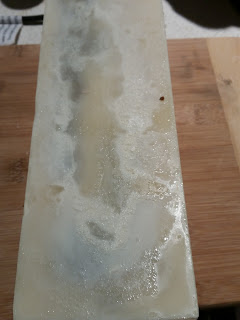
Underside of Soap unmoulded too early
  Little beads of what appeared to be moisture were seen to be   sitting on top of the loaves.  What could this be?  Was it    
  perspiration?  This didn't make sense as it is currently winter
  where I live.  Was the soap too lye heavy?  To be sure, I  
  decided to touch the soap with the tip of my tongue. ZAP!!  
  Hmm, I thought to try again in another spot.  ZAP!! ZAP!!
  By this stage thoughts of "Stop zapping yourself" chanted by
  Nelson from The Simpsons sprang to mind.  Don't laugh,  
  this is a real way to check to see if soap is too lye heavy and
  is known as the zap test (for obvious reasons).

  Having decided that my soap was too lye heavy, I decided to
  completely unmould the soap and shred for rebatching.  As I
  pulled the soap from the mould, I discovered a very thin  
  layer of oil on the bottom.  Could it have been possible that I
  unmoulded the soap too early??  My soap usually is ready to
  unmould after 24-30 hours.  Having resigned myself to failed
  soap, I thought I might as well leave it for a couple of extra  
  days.

After another 24 hours, I cautiously stuck my tongue on the soap. . . Nothing!!  No zapping for me 24 hours later, moisture on top disappeared and the thin layer of underneath had disappeared!!

What did this mean??  I was too impatient and should have waited longer.  I hadn't taken into consideration the fact that the room temperature where they were curing was a lot colder than usual.  I also didn't stop to think about how I had poured the batter into the mould when it was at only a thin trace just after emulsifying instead of my usual medium trace consistency.  These two factors would have added to a longer curing time.  In my haste to unmould too early, I now have an ugly pattern on the underside of one loaf caused from I believe where I had broken the 'seal' of the mould and the oil did not absorb / form into the soap evenly.


What Have I Got to Lose?

It has been months since I made any soap.  I guess I could say that I lost track of the time or that other priorities have taken place in my life.  The truth dawned on me last weekend.  Simply put, I have lost my nerve.  Since the end of last year, a few things occurred at work (AKA my non-soapy job) including a large scale restructure which resulted in 217 people being made redundant.  Although I kept my job, it has unsettled me, and I wonder how much longer before I too become redundant.  Until now I hadn't realised how much it had impacted on my life.  I know I have been keeping my head down and grateful that I have not lost my job but afraid to take risks (not reckless).  The redundancies have had a spillover effect into my home life and hobbies / interests.

For so long now, I have been making just honey and oatmeal soap.  Don't get me wrong; I love my honey and oatmeal soap but after awhile my soapmaking feels bland.

Last weekend I forced myself to get back in the saddle after many months of feeling 'lost'.  I felt extremely anxious about making soap and challenged myself to step out of my comfort zone by trying new techniques and blends.

Challenge 1: Drop swirl design using Brazilian purple clay and French green clay as colourants.  Scented, with a blend of lavender, spearmint and vanilla followed by a sprinkling of dried heather on top.

Challenge 2: A blend of sweet and valencia orange and patchouli for that hippy feeling mixed into a batch if soap coloured with activated charcoal and paprika.  Decorated on top with a feathered pattern.


Beautiful pattern on top moments before the clingwrap
 saga coloured with activated  charcoal and paprika.
I actually had panic attacks and many bouts of tears about what could go wrong and made mistakes because of my nerves.

Batch 1 - I forgot to add salt to harden my bars, and I didn't think to blend some water with the clay initially to break up clumps.  The portions of batter that were mixed with the clay started to become a thick trace quicker than the uncoloured batter.  I'm not sure if it was because of the clay or because I only poured my essential oil blend into these portions of the batter.  The drop swirl became more of a plop swirl.

Batch 2 - Forgot to add the Vitamin E.  Placed clingwrap over the loaf mould after making a pretty feathered pattern on top, only to watch the wrap sag and destroy the pattern.

I'm really not sure how these are going to turn out but I feel more relaxed now.

Friday, 1 January 2016

2016 Soapy Resolutions


Ringing in the new year is traditionally for most people the time to set resolutions usually which have been forgotten or broken by the end of January.  I've decided to set myself soapy resolutions for 2016.  Some will be specifically for soap making but others will be to challenge myself to use botanicals in other ways.

Looking back, it will be 10 years this coming July / August since I took my first venture into making soap and bath products.  A lot has happened over this time and so I feel it is time to get 'back to basics' where I'm going to challenge myself each week to try something new or revisit a technique or design that has sat on the proverbial shelf waiting patiently to be the belle of the ball.

I've also decided that this year I am going to focus on creating blends for example that are reminiscent of places I've visited or memories that have a special meaning to me.

Below are some things I have already earmarked to challenge myself with:

Techniques - 
* Landscape designs
* Taiwan Swirl
* Brush Embroidery
* Ombre Gradient Soap
* Feathered ITP Swirl
* Wall Pour
* Embeds
* Clyde Slide

Soaps - 
* Salt bars
* Beer Soap
* Whipped Soap

Other -
* Massage Bars
* Exfoliating Bars
* Tea Baths
* Bath / Shower Fizzies
* Body Butter

Culinary - 
* Herbal Tea blends
* Culinary Lavender
* Herbal vinegars, honey, herbal infused oil 

Household Cleaners - 
* Herbal Carpet Cleaners
* Natural Cleaners etc

Already this is a really long list, so how am I going to achieve my resolutions?  By being organised.  I've already scheduled weekly reminders in my calendar for a) planning the next week challenge and b) setting time aside to create the existing week challenge.  I also plan to mix it up i.e one week make soap, the next week using botanicals in my cooking etc.

Happy New Year everyone

Wednesday, 30 December 2015

Unmolding My Soap

The soap fairies have worked their magic and my batch of Honey & Oatmeal soap as been unmolded.

I am really happy with the results.  The silicone cylindrical mold leaves a lovely glossy surface to the soap.

Unmolding the soap from the cylindrical mold


I'm loving the marbled pattern that has been created.

 I wonder what the soap will look like once it has been cut?


Experimenting with patterning on the surface made using a bamboo skewer.

Happy with how this turned out considering how thick and quickly the trace became.


Getting Back In The Saddle

Some say soap making is like riding a bike.  Once you've learnt how you never really forget.  Sure you might fall off but it is important to get back on and keep going.

Where has the time gone?? This year has flown by so quickly that until yesterday I didn't realise that it has been almost 12 months since my last batch of soap.  Why did I leave it so long?  There are a number of possible reasons.

1) I started a new job at the end of last year.

2) We moved interstate and took a long time to adjust to the reality of downsizing from a house to a 2 bedroom apartment.

3) Dealing with the passing of  some special people in my life.

4) Trying to make time to complete work related course work.

5) Supporting my husband whilst he was in between jobs a we settled into our new lives.

6) Travelled back to the UK to visit family.

Or perhaps I simply lost my creative spark.  I don't know what happened but late last week my husband asked me when I was planning to make some more soap as the stash of my honey and oatmeal soap had been depleted and how he really likes it.

His comment took me by surprise as I hadn't realised how much he likes my soaps.  He also noted that he knows soap making makes me really happy.

So with this in mind yesterday I set aside time to make a double batch of my honey and oatmeal soap that is made with olive oil, coconut oil, rice bran oil. cocoa butter, vitamin e, honey, oatmeal, lye


Honey poured into traced soap

On the whole I thought I had it in the bag but boy had I forgotten a few things.

I forgot;

1) That the lye solution takes alot longer to cool down than what I remembered.

2) Using a rand new stick blender can cause the soap to trace more quickly.

3) Honey can speed up acceleration.

You wouldn't believe how quickly my soap turned from a nice thin trace to the beginning of soap custard.  I was able to get it into my molds and thankfully this was planned as a simple log with no intricate patterning to be included.

The annoying thing is that I know all of the factors but somehow let them skip to the back of my mind.  Maybe it was because I have made this soap so many times before that I felt I didn't really need to think about it.

Well my soap seems to have turned out okay.  Time will tell when I remove it from its mold later on.

Has this frightened me away?  Absolutely not.  What I will do next time is be more prepared in advance.  I'll also take it easier with the stick blender and remember that less is more when it comes to using the blender.  I'm also going to make time each week in 2016 to get my mojo back.

Thursday, 10 September 2015

Luscious Lavender, Oh How I love Thee

Freshly harvested lavender 8/9/15
I love anything to do with lavender from seeing fields of purple hues through to its distinct aroma as you brush past a plant or gently crush its buds.  I know it is sometimes unfortunately seen as a"spinster old aunt" kind of plant, a label unfairly penned in my opinion.

For over 2000 years, lavender has been used for hygienic, cosmetic, medicinal and culinary purposes.  Surely so many uses and people over this vast time span couldn't have been wrong?

So what's this got to do with soap making?  Well for me quite a lot.  Yesterday I helped to harvest some lavender and this put me back in the mood for making soap as soon as I get back from my holidays.  The tough decision which of my favourite blend of essential oils will I choose and what designs will I decide on for my soap?  Some of my favourite lavender EO blends include:

Lavender & Vanilla

Lavender & Spearmint

Lavender, Sweet Orange & Ylang Ylang

Lavender, Rose & Bergamot

Lavender, Roman Chamomile & Sandalwood

Lavender, Lemon & Rosemary

I wonder what other people's favourite lavender blends are??

Saturday, 22 August 2015

* Part 3 of Three New Soaps * Naturally Color Cold Process Soap *

This is an oldie but one I really love.  MyCherriCola has combined natural colourants to create a truly exquisite looking bar of soap which goes to show that gorgeous creations can be achieved using what nature provides us.  The cranberry seeds add that 'wow' factor.

If you are interested in using natural colourants in your soap creations then check out MyCherriCola's other YouTube videos.  They have definitely inspired me to start experimenting after I get back from holidays.


https://youtu.be/pSa_-1oIqUY

Saturday, 23 August 2014

Honey & Oatmeal Soap, Yumm


I've just finished wrapping my natural honey & oatmeal palm oil free soaps ready to take with me to show my girlfriends next week when I catch up with them.  I hope they like the packaging.  I love this simple yet exquisitely moisturising soap made up of local Australian honey, oatmeal, saponified: olive oil; coconut oil; rice bran oil and cocoa butter.  It is not fragranced by any essential oils but I can definitely smell the cocoa butter and there is very light aroma of honey.  I first made a similar bar some 7/8 years ago for my husband to use with his dry skin.  I also suffer from dry skin patches and find this bar really moisturises  my skin.  Over the years I've tweaked and adapted the original recipe until I am happy with the one I have now.  Unlike many large companies that mass produce soap, I make my soap using the cold pressed method,  because of this, glycerin a natural by product of the saponification process is retained in my soaps and not removed to be used in other products.


This soap is good enough to eat so to be on the safe side I made sure I placed a label on the back clearly stating "Do not eat" :-)

Tuesday, 19 August 2014

Too Much Lye Is Never A Good Thing

It doesn't matter whether you are an experienced or newbie soap maker, what matters is how accurately you measure your ingredients particularly when making cold pressed soap.I realised after measuring some of my ingredients for my last batch of honey & oatmeal soap that my electronic scales were playing up.  I hoped for the best and chose to keep soaping.


Yuck, look at what my end result was.  Too much lye in the mixture resulted in something that was very brittle and unpleasant, definitely too harsh to use on the skin as it is.  My trusty old scales have now been sent to greener pastures and a shiny new set are waiting to be used.

Monday, 18 August 2014

Baby Shower Soaps All Wrapped & Ready To Go


Well the time has come to share pictures of the soaps and tea baths I made for my niece to give as thank you gifts for her baby shower..  I've been patient, truly I have and only snuck a peak at them once or twice while they were curing.  The cupcake soaps had a rattle stuck in the top and the bars of soaps were wrapped in 'nappies'.  All were made using vegetable oils, Essential Oils and natural colourants.


Wednesday, 6 August 2014

Infusing Oil - Natural Colourants


Ooh,  I'm very excited to share this photo of natural colourants infused in olive oil.  I love the range of colours and hues produced by a variety of herbs, spices and clays.

Later today I plan to test these in my basic soap recipe as I am curious to see if the colours will hold up during the soap making process.  So far I have infused the following colourants:  activated charcoal, ground coffee,  powdered rosehips, calendula petals, cocoa powder, French red clay, parsley, powdered indigo,  turmeric, paprika,  cayenne pepper,  spirulina & cinnamon.

Friday, 1 August 2014

Why I Choose To Make My Soaps Palm Oil Free

 To use palm oil or not is a debate that people in the soaping community have some strong views about, as I personally experienced whilst on holiday in Queensland a few months ago.  I was visiting a well known tourist area  in the tropical rainforest region and spotted a store that sold handmade soap and other toiletries.   I love trying other handmade and supporting small businessesproducts and I was looking at the products when the store owner approached me.

As usual they gave the usual spiel about how the soaps were made from hand etc and when asked what method was used to make the soap, I was promptly told "that it was by a little old method that I wouldn't know about called cold process soap making".  Now I was raised to be polite, but they really made my ears prick up and my nostrils flare at  the condescending attitude of store owner.  I thought keep calm and ask if they stocked any palm oil free soap.  Big mistake,  I was  subjected to another discussion about how cold process soap could not be made without the use of palm oil, how they use palm oil sourced from sustainable sources.  Great news that they use sustainable oil but no where did they have this advertised whether on their packaging or elsewhere.  I know it's not mandatory but if they are going to be passionate about using sustainable palm oil wouldn't you think they would advertise it?

 I couldn't believe how much ill informed information I was hearing. I had had enough and decided that it was time to tell  the person that indeed I did know about the cold process soap making and that it is possible to make palm oil free soap. The picture attached to this post is an example of a palm oil free soap I made using olive oil, coconut oil, cocoa butter, rice bran oil and turmeric as a colourant.

 I have been making cold pressed soap since 2007 and started out using palm oil in my soap.  Over the years however,  I became aware of issues relating to the over exploitation of palm oil plantations in Borneo and Sumatra in South East Asia such as  mass deforestation,  species such as Orangutans and the Sumatran Tigers being  threatened with extinction.  Not to mention the exploitation of the indigenous communities and loss of their lands.

There are on the other hand, convincing arguments for using sustainable palm oil.  For example, that soap makers contribute to only 1% of all palm oil consumption and that per unit area, palm oil makes 10 times the amount of oil as soybeans,  grapeseeds or sunflowers, it is therefore in some ways more environmentally friendly.

So why use palm oil in soap making?  Not only does palm oil  add firmness to a bar of soap, it also contains conditioning properties for the skin.  These can also be achieved by using oils such as rice bran, and coconut oil.

Palm oil is now the most widely used vegetable oil and can be found in so much processed food As well as a plethora of other products such as shampoo.  Take a look when next out shopping at the ingredients label and see how it is used even in pastry products.  Can I make a difference? I hope so.  It  is for this reason that I have decided to make palm oil free products.

If you are buying hand made soap and other products, I encourage you to choose ones that are either palm oil free or at least ones that confirm only sustainable palm oil is used in the making of the products.